How SprinklerMap places sprinklers automatically
One garden, four algorithms, four different layouts. What each one optimises, the arrangement it produces and when to pick it — with screenshots from the same real case.
August 16, 2026
The problem automatic placement has to solve
Arranging sprinklers in a garden has no single right answer. The requirements pull in opposite directions:
- Cover the whole surface: every square metre of lawn must get water from at least one sprinkler, otherwise a dry patch is left behind.
- Overlap the throws: the head-to-head principle requires the distance between neighbouring sprinklers never to exceed the radius, because a sprinkler delivers far less water at the end of its throw than close to the head.
- Keep water inside: water on paths, walls and fences is wasted water and damaged surfaces.
- Use few sprinklers: every extra head is a cost, another trench and a share of flow taken away from the circuit.
No single arrangement maximises all of them at once: more overlap means more heads, fewer heads open coverage gaps. That is why SprinklerMap does not offer one automatic layout but four: two independent strategies — Perimeter priority and Area priority — plus SACO, a newer family with two variants, Halton and Voronoi, that share the same goal but start from a different method.
This page describes what each algorithm optimises and what layout it produces, not how it gets there internally. The criteria are public and verifiable against the results; the implementation is not.
The test garden: one garden for all four
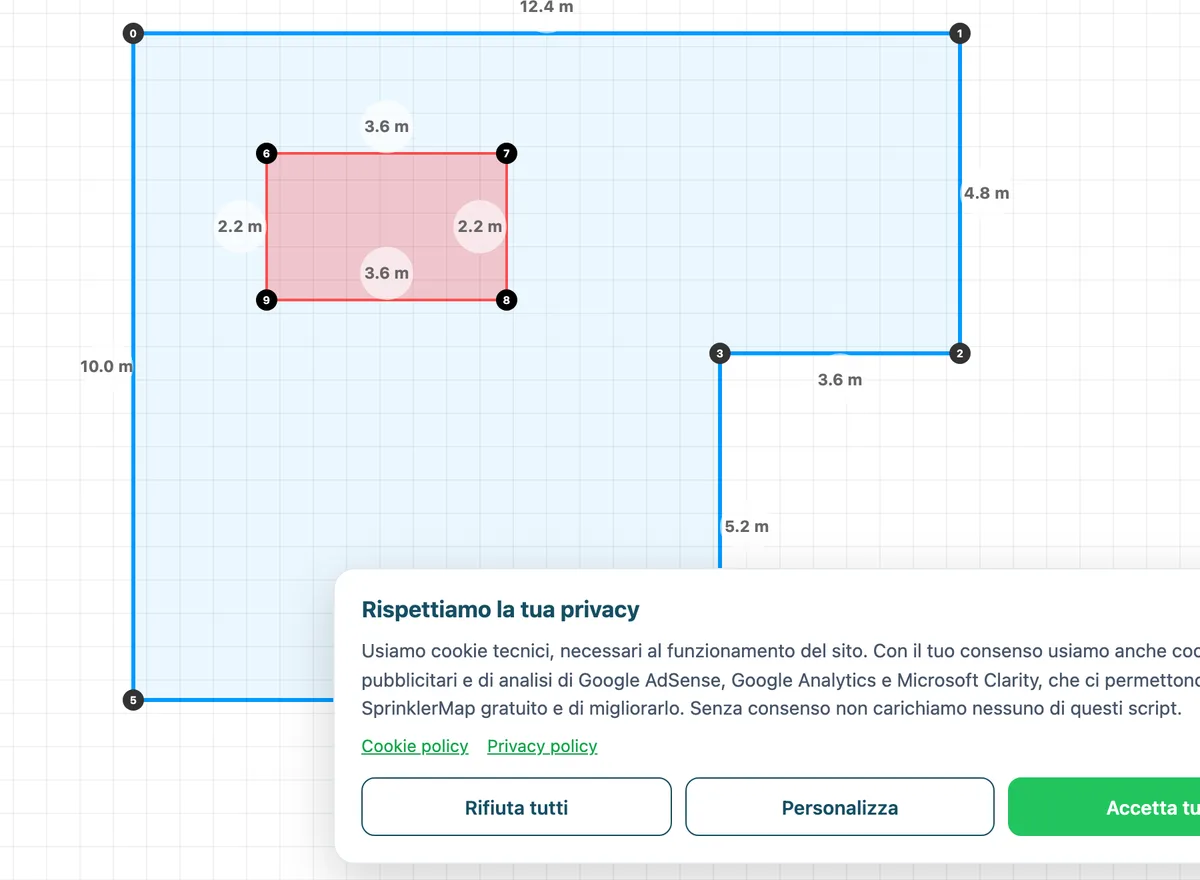
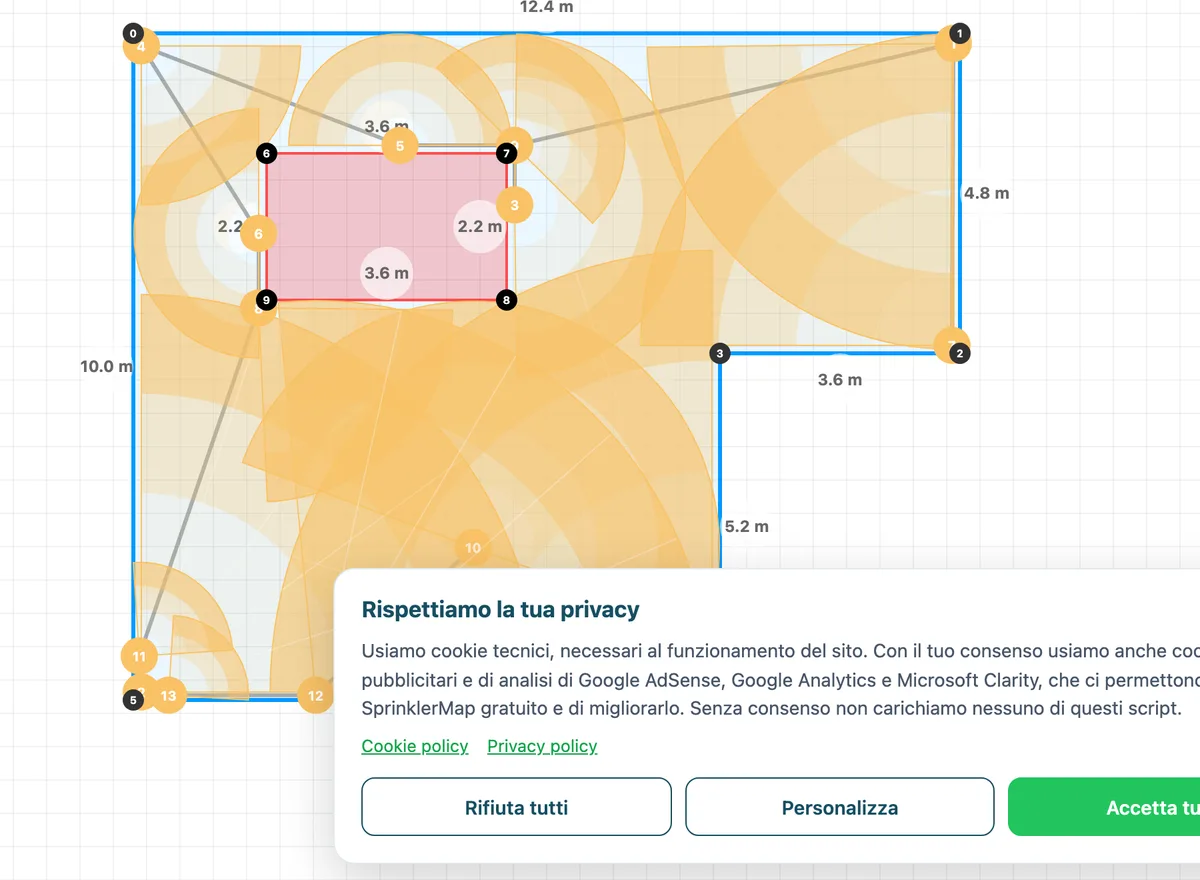
Comparing algorithms on different gardens tells you nothing. Every screenshot on this page comes from the exact same garden, drawn once: an L shape of 12.4 × 10.0 m with a 3.6 × 2.2 m patio excluded, leaving 97.4 m² net to irrigate.
The shape is awkward on purpose: a perfect rectangle would make all results look alike and would hide exactly the differences you need in order to choose. An L with an excluded area in the middle is what a real garden actually looks like.
Perimeter priority: the installer's layout
What it optimises: keeping water inside the boundaries. It puts a sprinkler near every corner and along the edges, with all throws aimed inwards.
The layout it produces: predictable and easy to read. Sprinklers sit on the edge, so the pipe run can follow the perimeter and the trench stays along the boundary, where it is least disruptive. It is the arrangement an experienced installer would use without doing any maths.
On the test garden: 6 sprinklers, 74.7% of the surface covered. With 90° sectors on the corners and radii between 2.5 and 6.6 m, virtually no water lands outside the perimeter.
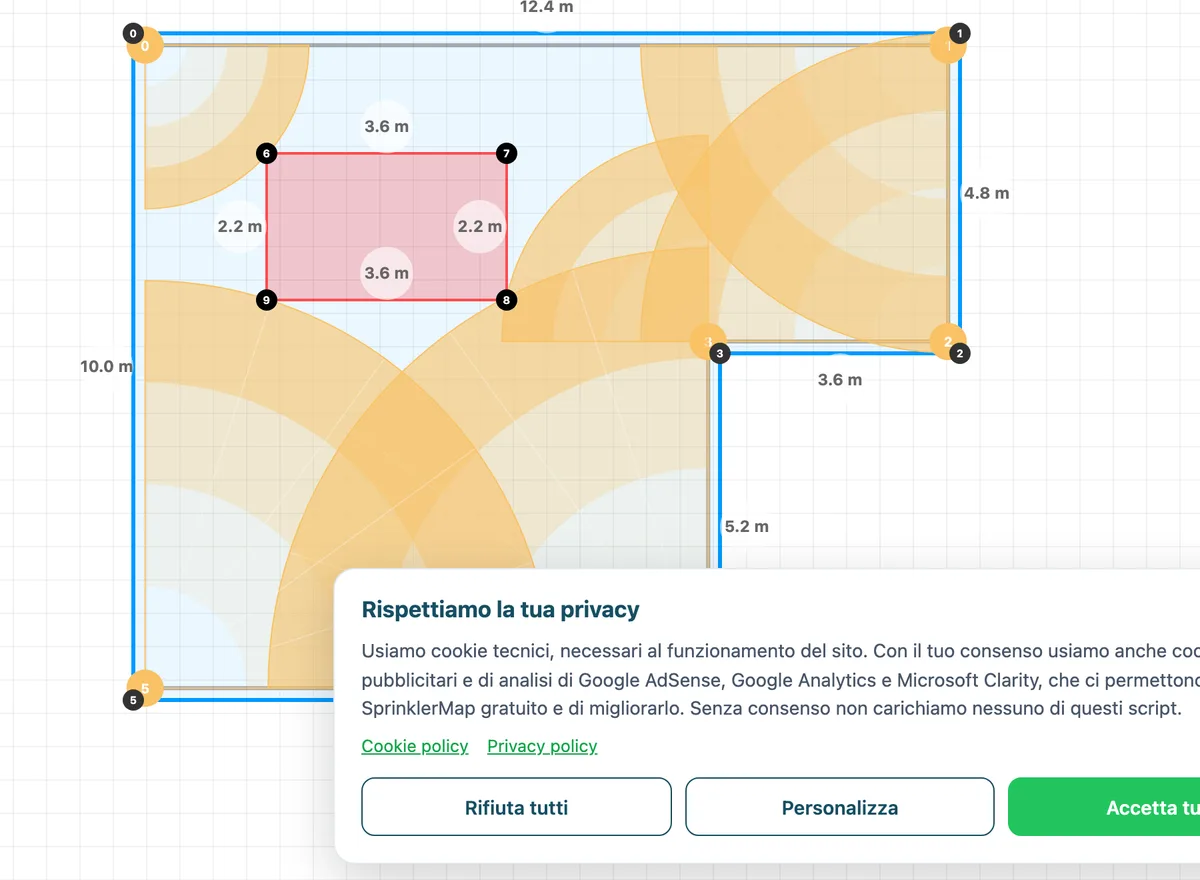
When to pick it: small and medium gardens, regular shapes, and whenever wasting water past the boundary is the main problem — a lawn surrounded by paths, walls or a neighbour's hedge. It is also the easiest to adjust by hand, because the logic of the arrangement is obvious at a glance.
Area priority: fewer, wider circles centred on the surface
What it optimises: the sprinkler count. Instead of chasing every corner, it places a few wide-radius sprinklers at the points that cover the largest possible share of the surface.
The layout it produces: a handful of large circles, almost always full-sector, in the widest zones of the garden. Tight corners and irregular pockets stay uncovered by choice, not by mistake: covering them would need extra short-radius sprinklers, exactly what this strategy avoids.
On the test garden: 4 sprinklers, 63.7% of the surface covered — the fewest heads of the four strategies, but also the lowest coverage: the L shape leaves uncovered the corners that a few wide circles cannot reach.
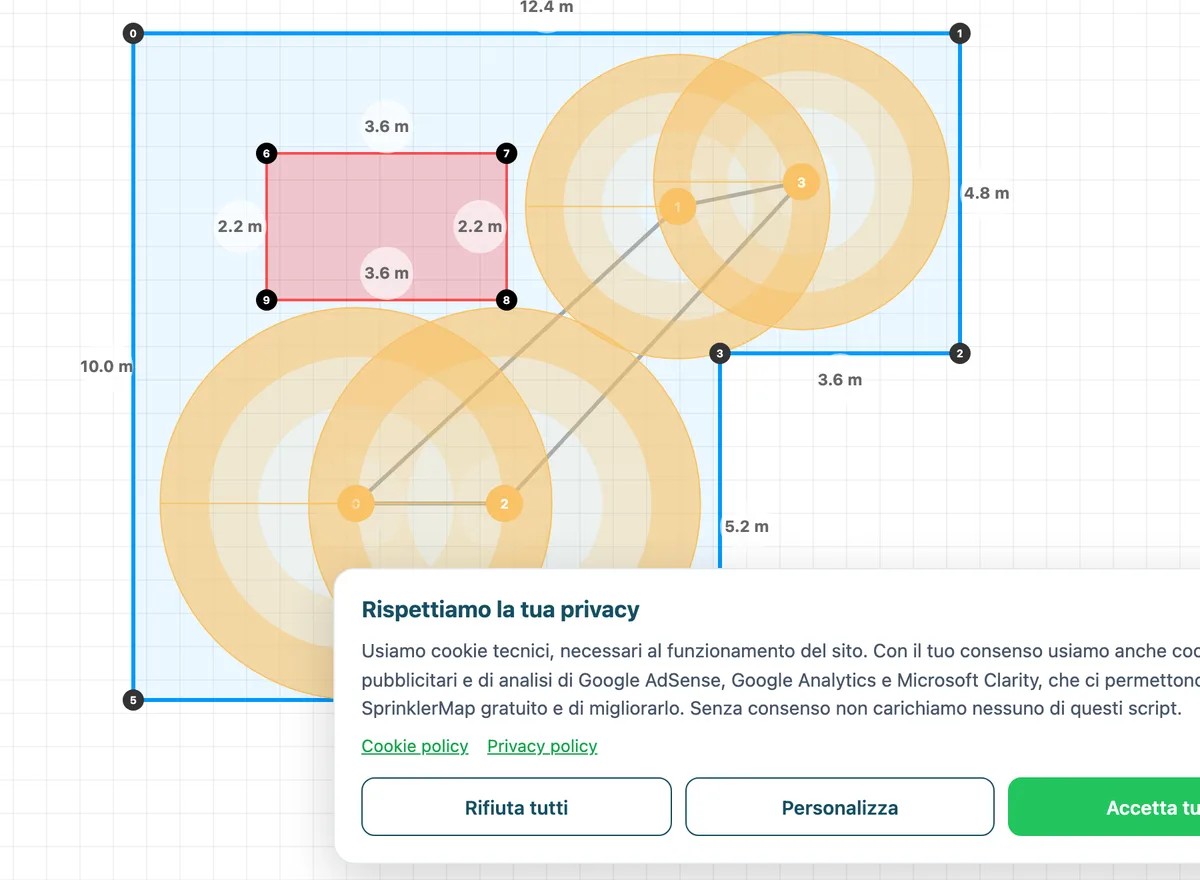
When to pick it: when few sprinklers and low maintenance matter more than covering the full edge, on surfaces regular enough to be covered with a few large circles. On jagged shapes, or when the corners need watering too, perimeter priority or one of the two SACO variants remains the more efficient choice.
SACO: one family, two variants for the starting point
SACO (SprinklerMap Adaptive Coverage Optimizer) is the newest family and works differently from the other two strategies: instead of deciding where the sprinklers go and then adapting their radius, it chooses position, radius, direction and sector width of every sprinkler together, judging the configuration as a whole.
What it optimises: a stated goal, shared by both variants — covering at least 90% of the garden with as few sprinklers as possible, with no radius below 1 metre. The two variants differ only in how they generate the starting points the proposal is built from.
Halton: starting points spread out evenly
Generates candidates from a quasi-random but uniform sequence across the whole surface, independent of the garden's shape.
On the test garden: 12 sprinklers, 87.8% of the surface covered.
Voronoi: starting points spread out by free space
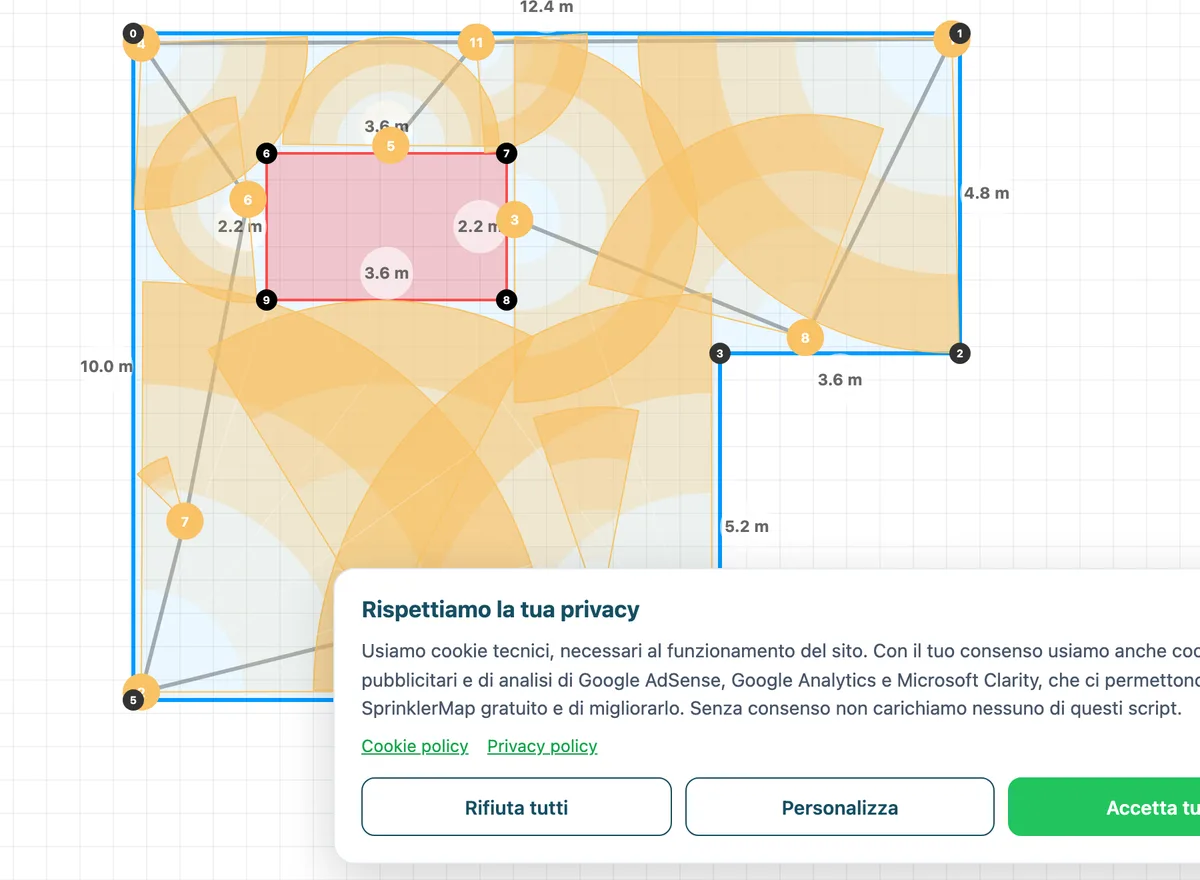
Generates candidates based on how much free space is left around each point: it tends to propose more sprinklers in the widest, most open zones of the drawing.
On the test garden: 14 sprinklers, 89.0% of the surface covered — a few more heads than Halton on this garden, for slightly higher coverage.
Two behaviours the other strategies do not have
- They say so when they cannot get there. If 90% is not reachable on that geometry with sensibly sized sprinklers, both variants state it explicitly and report the coverage actually achieved, instead of silently returning a poor layout. They are the only two of the four strategies that distinguish between "this is the result" and "this is the best I found, and it is not enough".
- Every press proposes a different configuration. That is not a defect: on the same geometry many arrangements of comparable quality exist, and seeing more than one helps you pick the one that best fits the real obstacles in the garden, which the drawing does not know about. If a layout convinces you, save it — the next press proposes another.
Both SACO variants are marked experimental in the app. The layout they produce is a starting point to verify, not a construction drawing — and the numbers measured above come from one representative run, not a fixed value repeated on every press.
The four strategies side by side, same garden
Perimeter priority and area priority are deterministic: same drawing, same result on every run. The two SACO variants are not — they propose a different configuration on every press, so their values below come from one representative run on the same 97.4 m² drawing, not a fixed number. The percentage is always the share of surface reached by at least one sprinkler, measured the same way for all four: a like-for-like comparison, not four different metrics.
| Strategy | Sprinklers | Surface covered | Best for |
|---|---|---|---|
| Perimeter priority | 6 | 74.7% | Small and medium gardens, regular shapes, priority on not overspraying |
| Area priority | 4 | 63.7% | Few heads and low maintenance, regular surfaces, uncovered corners acceptable |
| SACO Halton | 12 | 87.8% | Irregular shapes, excluded areas, a general-purpose starting point |
| SACO Voronoi | 14 | 89.0% | Like Halton, with a few more heads when there is a lot of free space to use |
The sprinkler count should not be read on its own: what matters is which layout covers the corners or pockets you actually care about, not just the total percentage. That is why the app offers a choice instead of deciding for you.
A note on the percentage: it measures how much surface receives water, not how evenly it receives it. Those are two different qualities, and the second one is checked with the water simulation.
What automatic placement does not do
Stated limits matter as much as features. Automatic placement:
- Does not know about obstacles you did not draw. A tree, an inspection chamber, a change in level or a patch of compacted soil is not in the drawing, so it is not in the calculation. Areas to exclude must be drawn as holes.
- Does not choose the commercial model. It assigns a nozzle type based on radius — spray below 5 metres, rotator above — but brand and series remain your choice, and they change flow and operating pressure.
- Does not split the system into hydraulic zones. The number of circuits depends on available flow and pressure; that is a separate calculation, described in the calculation methodology.
- Does not account for wind or for slopes above 15%, which distort the real throw compared with the theoretical circle.
- Does not replace verification. A layout with good coverage can still distribute water badly, or apply it faster than the soil can absorb.
So the next step is not installing — it is checking.
Next step: verify the layout with the simulation
Coverage tells you the water arrives. It does not tell you whether the right amount arrives, nor whether it arrives faster than the soil can take it. Those are the two questions the app's water simulations answer, working on the layout you just generated.
How the two water simulations work →
Related reading: the head-to-head rule explains why overlapping throws is not optional, and the design guide covers water need, zoning and the materials list.
Frequently asked questions
What's the difference between the 4 automatic placement strategies?
"Perimeter priority" places sprinklers on the vertices and along the edges, all aimed inwards: 6 sprinklers, 74.7% coverage on the test garden, almost no water past the boundary. "Area priority" uses a few wide-radius sprinklers centred on the widest zones, leaving corners uncovered by choice: 4 sprinklers, 63.7% — the fewest heads but also the lowest coverage of the four. "SACO" is a family with two variants that choose position, radius, direction and sector of every sprinkler together: "Halton" (12 sprinklers, 87.8%) spreads starting points evenly, "Voronoi" (14 sprinklers, 89.0%) spreads them by free space. Both state explicitly when they fall short of the target instead of silently returning a poor layout.
When should I pick "Perimeter priority" over the other strategies?
On small and medium gardens, regular shapes, wherever wasting water past the boundary is the main problem — a lawn surrounded by paths, walls or a neighbour's hedge. Sprinklers stay on the edge, so the pipe run follows the perimeter and the trench is least disruptive. It's also the easiest to adjust by hand, because the logic is obvious at a glance: if a patch stays dry, just move two neighbouring sprinklers closer. When few sprinklers and low maintenance matter more than edge coverage, area priority is the better fit; on irregular shapes, with excluded areas, or when total coverage is what matters, one of the two SACO variants is the more efficient choice.
What's the difference between the two SACO variants, Halton and Voronoi?
They share the same goal — covering at least 90% of the garden with as few sprinklers as possible — and differ only in how they generate the starting points the proposal is built from. "Halton" spreads them in a quasi-random but even pattern across the whole surface: on the test garden 12 sprinklers, 87.8% coverage. "Voronoi" spreads them based on the free space around each point, usually proposing a few more sprinklers in the widest, most open zones: 14 sprinklers, 89.0% on the same garden. Neither is always better than the other, and both propose a different configuration on every press — it's worth trying both on the same drawing and comparing the results.
What does automatic placement NOT take into account before installing?
Five things, stated explicitly: it doesn't know about obstacles you haven't drawn (trees, inspection chambers, changes in level — add them as holes); it doesn't choose the commercial model, only the nozzle type based on radius; it doesn't split the system into hydraulic zones, a separate calculation that depends on flow and pressure; it doesn't account for wind or slopes above 15%, which distort the real throw; and it doesn't replace verification — a layout with good coverage can still distribute water unevenly or faster than the soil can absorb it. That's why the next step is always to verify with the water simulation, not to install directly.